
Tree Cabling & Bracing
Tree Cabling & Bracing Pittsburgh — Structural Support For Your Valuable Trees
ISA Certified Arborists.
ANSI A300 Compliant Installation.
Residential & Commercial.
Free Estimates.
Not every structurally compromised tree needs to come down. A large, mature oak with a co-dominant stem, a historic maple with a splitting crotch union, or a shade tree with a heavy overextended limb can often be preserved for fifteen to twenty-five additional years through professional tree cabling and bracing — at a fraction of the cost of removal and replanting.
Tree cabling and bracing is one of the most technically demanding services in professional arboriculture. Installed correctly — by an ISA Certified Arborist following ANSI A300 Part 3 standards — a support system meaningfully reduces the risk of structural failure, buys valuable time for other tree care interventions, and keeps mature trees that define your Pittsburgh property standing safely for decades to come. Installed incorrectly, it fails silently and creates a false sense of security that may be worse than no system at all.
Our ISA Certified Arborists assess, design, and install tree support systems throughout Pittsburgh, PA, Allegheny County, and Greater Pittsburgh — with a commitment to honest recommendations, industry-standard materials, and the technical precision these systems demand.
What Is Tree Cabling and Bracing?
Tree cabling and bracing are supplemental support systems installed in trees with structural defects or conditions that pose an elevated risk of failure. They do not repair the tree — trees cannot heal structural damage — but they reduce the load and movement at the weak point, limiting the stress that could trigger failure under wind, ice, or the tree's own weight.
These systems are governed by ANSI A300 Part 3 (Cabling, Bracing and Guying Established Trees) and the ISA Best Management Practices for Tree Support Systems — the national standards that define correct materials, placement, and inspection requirements for every professional installation. Any cabling or bracing system not installed to these standards is, at best, cosmetic and, at worst, a liability.
Importantly, tree cabling and bracing is appropriate only for trees that are otherwise structurally sound — healthy trees with isolated structural defects. It is not a rescue treatment for trees in serious decline, infested with destructive pests, or experiencing advanced trunk decay. Distinguishing between trees that are good candidates and trees that are not is precisely what an arborist assessment determines, and it is the most important step in the entire process.
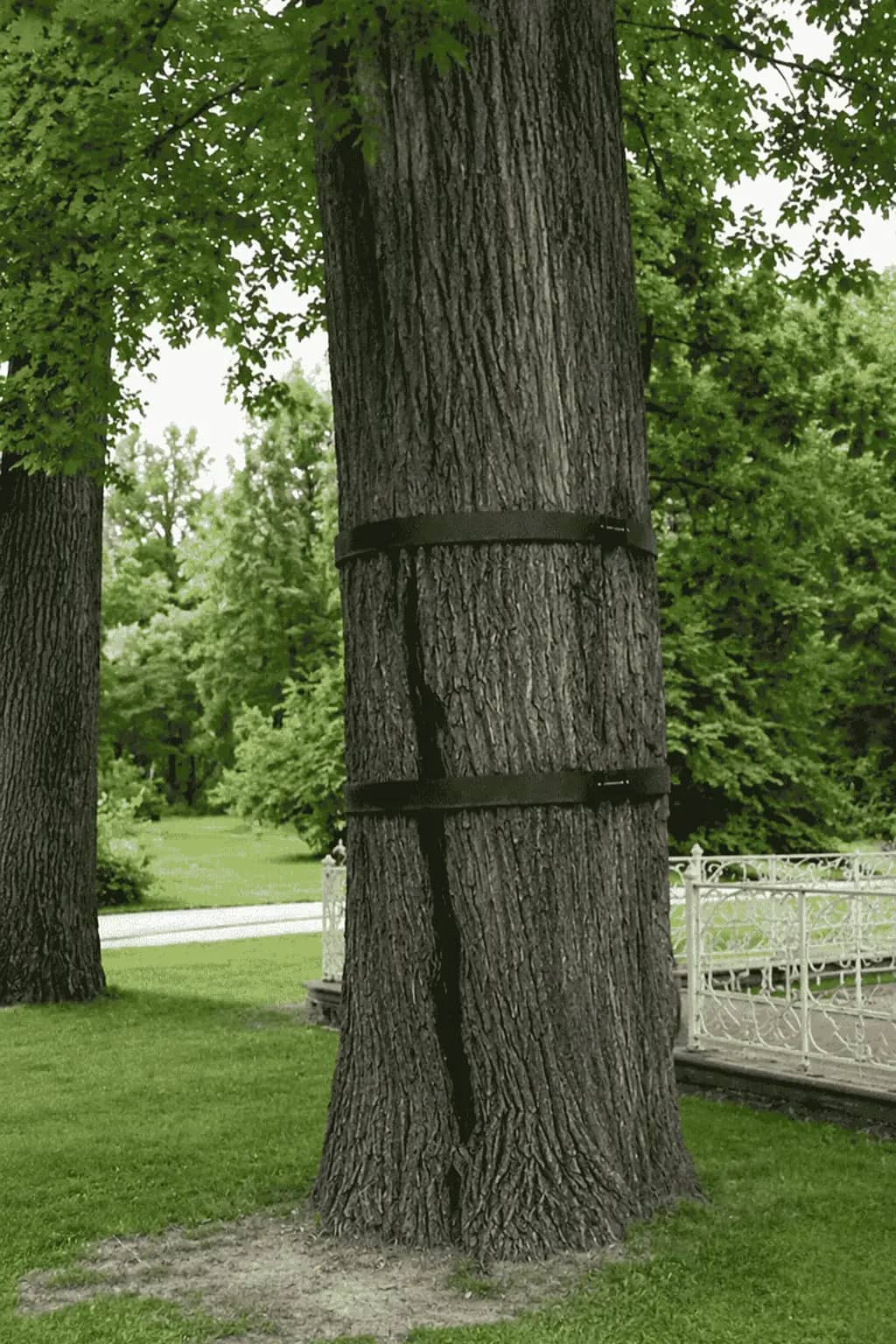
Tree Cabling Vs. Tree Bracing — Understanding the Difference
Cabling and bracing are two distinct interventions that address different structural problems. They are frequently used together on the same tree when both issues are present.
Tree Cabling
Tree cabling installs high-strength steel cables between branches, leaders, or co-dominant stems in the upper crown of the tree to limit relative movement between them. When two or more major stems grow at narrow angles from a shared union — what arborists call a co-dominant stem arrangement — each stem's growth pushes against the other as they expand in diameter, eventually creating a splitting force at the union that no amount of natural wood strength can permanently resist.
Cables are installed in the upper two-thirds of the canopy, above the union point, at attachment positions calculated from the limb weight, lever arm length, and the anticipated load from wind and ice accumulation. Installed correctly, a properly designed cable system reduces stress at a weak union by sixty to eighty percent — a dramatic reduction in the force that would otherwise cause the stems to split apart during a storm event. Pittsburgh's ice storms and summer thunderstorms make this reduction especially meaningful for mature trees with co-dominant architecture.
The most common cabling candidate in Pittsburgh's urban tree population is the mature red or white oak with a V-shaped crotch and included bark — a condition where bark grows inward between co-dominant stems instead of forming a solid wood-to-wood union. Under load, these V-shaped unions fail suddenly and catastrophically, splitting the tree in half. Cabling extends the safe life of these trees while combined pruning reduces the weight and wind resistance of the stems involved.
Tree Bracing
Tree bracing installs threaded steel rods or bolts directly through a split, cracked, or open crotch union to prevent the two sides from spreading apart. Where cabling limits movement between leaders in the upper crown, bracing provides rigid support at the actual point of structural failure — typically a trunk split, an open crotch union, or a crack in a major scaffold branch. Bracing rods are sized and positioned based on the diameter of the wood being joined and the anticipated load direction.
Bracing is often combined with cabling — the rods prevent the split from opening while the cables above limit the movement that creates splitting force in the first place. Together, the two systems address both the symptom and the mechanical cause. Our certified arborists evaluate each structural defect individually to determine whether cabling alone, bracing alone, or a combined system is the appropriate intervention.
Dynamic vs. Static Cabling Systems
Traditional static cabling systems use rigid steel cables that provide a fixed limit on branch movement. Dynamic cabling systems use flexible synthetic materials that allow some movement while still limiting the extreme displacement that causes failure — more closely mimicking the natural flexibility of a healthy tree's branch structure. Dynamic systems are preferred in some situations because they do not create the rigid resistance points that can, over time, cause wood to adapt in ways that weaken attachment around the hardware. Our arborists assess each tree's specific structural condition, species, and load profile to select the system type that best fits the situation.
Signs Your Pittsburgh Tree May Need Cabling or Bracing
Several structural conditions make a tree a strong candidate for a professional cabling or bracing assessment. Not all of these will require intervention — the severity, the species, the tree's overall health, and its proximity to structures all factor into the recommendation. But if you observe any of the following in a mature tree on your Pittsburgh property, a certified arborist assessment is warranted.
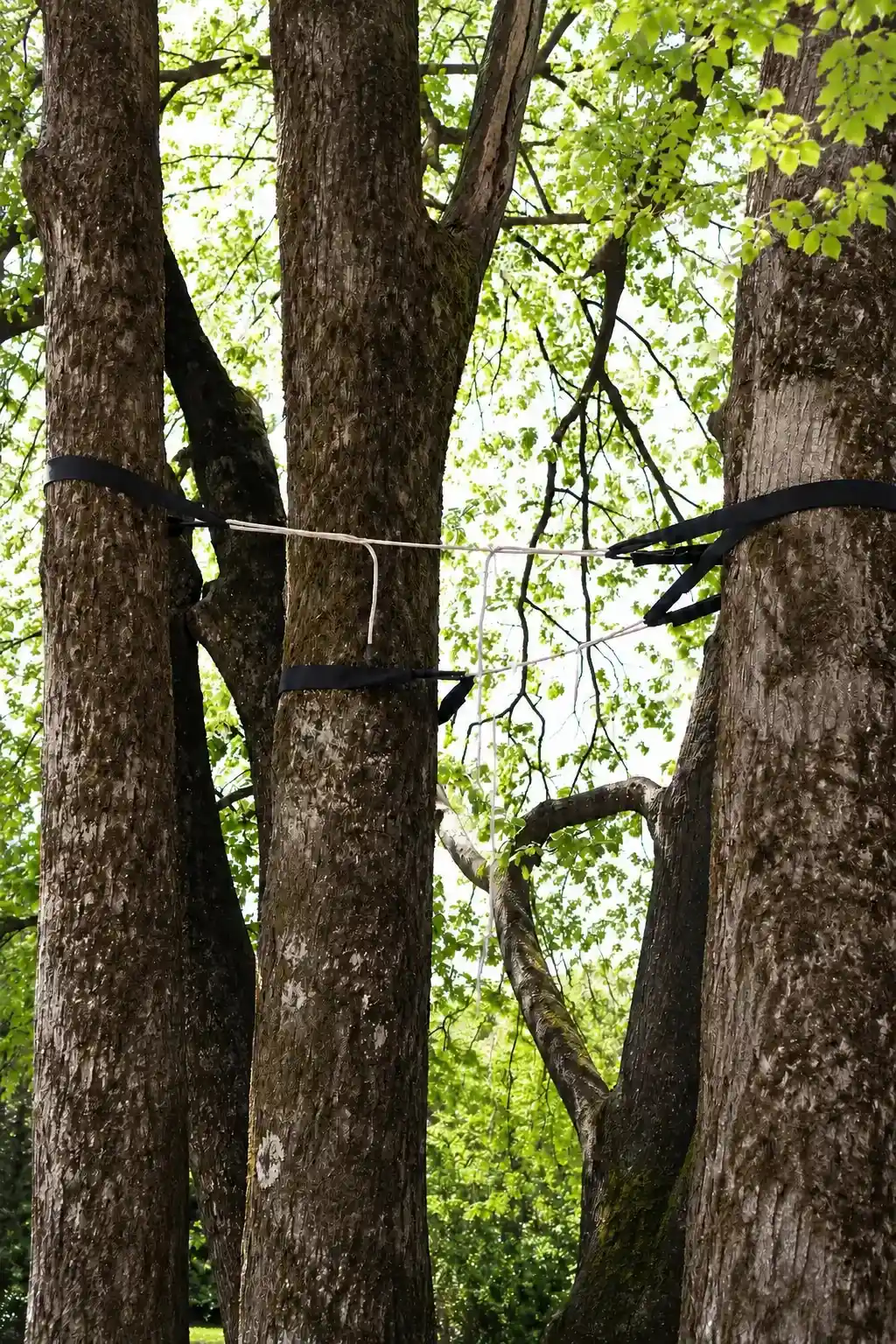
Co-dominant stems with a tight, V-shaped union. Two or more major stems growing from the same origin point at a narrow angle — particularly where a flat or sunken surface and included bark are visible at the crotch — is the single strongest indicator that cabling should be considered. This condition is common in mature oaks, silver maples, Bradford pears, and many ornamental species across Pittsburgh's residential neighborhoods.
A visible crack, split, or open seam in the trunk or major union. Any crack that has opened in the wood of the trunk or a major branch union is a structural failure that has already begun. Bracing rods can stabilize the split and prevent it from progressing, but only if the tree's wood on both sides of the crack retains sufficient integrity to hold the hardware.
Heavy, overextended lateral limbs. Large scaffold branches that have grown long and heavy relative to their attachment diameter create increasing lever arm force on the union as they continue to grow and accumulate weight. This is particularly common in mature oaks and ashes throughout Pittsburgh, where scaffold branches can extend fifteen to twenty feet from the trunk before reaching their terminus. Cabling provides an intermediate support point that reduces the bending force at the attachment.
Previous storm damage that stopped short of full failure. A branch or stem that partially split during a prior storm — enough to crack the wood or expose the interior, but not enough to fall — is a compromised structural element that has lost much of its original strength at the damage point. Professional evaluation determines whether cabling and bracing can rehabilitate the situation or whether the damaged section should be removed.
Trees on Pittsburgh's hillside terrain with unbalanced canopies. Steep slope sites — common throughout Pittsburgh neighborhoods like Mt. Washington, Brookline, Squirrel Hill, and the North Hills — often produce trees with significantly unbalanced canopy weight favoring the downhill side. This chronic lean increases the root system's structural load and raises the risk of failure during Pittsburgh's soil-saturating spring rainfalls. Cabling can compensate for canopy imbalance while corrective pruning gradually reshapes the crown over successive seasons.
Our Tree Cabling and Bracing Process in Pittsburgh
Every cabling and bracing installation we perform follows a structured process that ensures the right system is designed for the specific tree — not a generic one-size approach applied indiscriminately.
Full Structural Assessment
The process begins with a full structural assessment by our ISA Certified Arborist. We evaluate the tree visually from the ground and, where required, from within the canopy — examining the crotch unions, bark inclusion, crack patterns, wood soundness, canopy weight distribution, and root zone condition. Where the soundness of internal wood is in question, we may use sounding assessments to identify decay chambers that would compromise the holding strength of hardware. The full health and structural condition of the tree must be understood before any hardware is designed or installed.
Design the Support System
From that assessment, we design the support system: the type of cable or brace, the attachment points, the hardware sizing, and the positioning height relative to the union being protected. Cables are positioned to intercept the displacement force at the point in the canopy where limiting movement is most mechanically effective — typically in the upper two-thirds of the canopy height above the weak union. Bracing rods are sized to the wood diameter they are joining and torqued to specifications that grip firmly without crushing the surrounding wood tissue.
Install Support System
Installation follows the ANSI A300 Part 3 standard for all materials and techniques. We do not use improvised hardware, inappropriate grades of steel, or attachment methods that damage the cambium layer or create future decay entry points. The system is checked for tension, alignment, and hardware engagement before we leave the site, and we provide you with written documentation of the system installed, its components, and its inspection requirements.
When Cabling Is the Right Choice — And When It Is Not
Tree cabling and bracing is one of the most preservation-positive services in professional tree care, but it is not appropriate for every situation. Our certified arborists will always tell you honestly which category your tree falls into — because installing a cabling system on a tree that is not a genuine candidate wastes your money and may mask a problem that should be addressed differently.
Cabling works well when the tree is otherwise healthy, the structural defect is isolated to a specific union or limb, the wood at the attachment points is sound enough to hold hardware under load, the tree's proximity to structures or people creates meaningful risk from a failure event, and the value of the tree — aesthetic, ecological, property, or sentimental — justifies the investment compared to removal and replacement.
Cabling is not appropriate when the tree has advanced internal decay in the trunk or major limbs, when root system failure has already compromised the tree's foundation and made it a falling risk regardless of crown support, when the structural defect affects the majority of the tree's crown rather than an isolated section, or when the tree is in serious decline from disease or pest infestation that cabling does not address. In these cases, our honest recommendation will be tree removal — and we will explain why clearly, with the specific findings that support that conclusion.
A cabling system that fails — because it was installed on a tree that was not a genuine candidate, or because it was installed without following ANSI A300 standards — provides no real protection and may give the property owner false confidence that a genuinely dangerous tree has been made safe. We will never install a system we do not believe in, because our reputation in Pittsburgh's tree care community depends on the long-term outcomes of our work, not just the short-term revenue from an installation.
Cabling Cost vs. Removal Cost — The Value Comparison
For many Pittsburgh homeowners, tree cabling and bracing is significantly more cost-effective than the alternative. A mature, large-canopy shade tree — the kind of red oak or sugar maple that gives your property its character and provides decades of cooling, privacy, and ecological value
— costs between $3,000 and $10,000 or more to remove safely, depending on size, location, and site access. A replacement tree planted at that site will take twenty to forty years to reach the same canopy size and provide comparable value.
A professionally installed cabling or bracing system in Pittsburgh typically ranges from $500 to $2,500 depending on tree size, canopy access, system complexity, and the number of attachment points required. For a sound tree with an isolated structural defect that can be safely supported, that investment extends the safe life of the tree by fifteen to twenty-five years — potentially indefinitely with annual inspections and appropriate supplementary pruning that reduces load on the supported structure over time.
The calculation is straightforward for any mature tree with genuine preservation value: a cabling assessment costs nothing, a cabling system costs a fraction of removal, and a tree that stands safely for another two decades instead of coming down this season represents an investment that pays back in property value, shade, carbon sequestration, and the irreplaceable aesthetic contribution of a mature urban tree.
Annual Inspections — Maintaining Your Support System
A cabling or bracing system installed today is not a permanent, maintenance-free solution. ANSI A300 Part 3 standards require that installed systems be inspected at regular intervals — at minimum annually, and after any significant storm event — to confirm the hardware remains properly tensioned, the attachment points have not been compromised by wood growth or decay, and the system continues to provide the supplemental support it was designed to deliver.
Trees grow. As the tree adds wood each year around the attachment hardware, the system's geometry changes, cable tension can shift, and eye bolts can become over-embedded in the growing wood if not monitored. A cable that provided meaningful load reduction at installation may become slack or ineffective without periodic adjustment. Synthetic dynamic cable systems should be physically inspected for wear, UV degradation, and connector integrity and replaced when the material has reached the end of its service life — typically every ten years for modern synthetic systems.
We offer annual inspection visits for every cabling and bracing system we install across Pittsburgh and Allegheny County, keeping a record of each system and providing written inspection reports that document the current condition and any recommended adjustments. This ongoing relationship is part of what we consider responsible tree support management — not a one-time installation and walk away.
Serving Pittsburgh, PA | Allegheny County & Greater Pittsburgh
We provide professional tree cabling, bracing, and structural support services throughout Pittsburgh, PA and the surrounding areas, including:
Pittsburgh neighborhoods: Squirrel Hill, Shadyside, Brookline, Mt. Washington, Lawrenceville, Highland Park, Oakland, Greenfield, East Liberty, Beechview, Hazelwood, and South Side.
South Hills: Bethel Park, Mt. Lebanon, Upper St. Clair, Baldwin, Castle Shannon, Dormont, Greentree, South Fayette Township, and Pleasant Hills.
North Hills & North Pittsburgh: Allison Park, Cranberry Township, McCandless Township, Ross Township, Gibsonia, Glenshaw, Wexford, and Mars.
West Pittsburgh: Carnegie, Bridgeville, Scott Township, Collier Township, Moon Township, Coraopolis, Sewickley, and McKees Rocks.
We serve all of Allegheny County and extend into Butler, Washington, Beaver, and Westmoreland counties across Western Pennsylvania.
Frequently Asked Questions — Tree Cabling & Bracing Pittsburgh
How do I know if my tree needs cabling or bracing?
The clearest signs are co-dominant stems growing at a narrow V-shaped angle — especially where you can see a flat, sunken, or bark-filled seam at the crotch — a visible crack or split in the trunk or a major union, or a heavy limb that visibly overextends past its branch attachment. Any of these conditions in a mature, otherwise-healthy tree warrants a professional assessment by an ISA Certified Arborist. The assessment is the right starting point, and ours are free — we will tell you honestly whether cabling is the right answer for your specific tree.
How long does a professionally installed cable system last?
Steel cable systems, when properly installed to ANSI A300 standards and inspected annually, typically function effectively for ten to twenty years before hardware requires assessment for replacement. Dynamic synthetic cable systems generally require replacement at around ten years due to material fatigue and UV degradation. The longevity of any system also depends on how the tree grows around the hardware — which is exactly why annual inspection matters. A properly maintained system on an otherwise healthy tree can function indefinitely through sequential hardware replacement.
Can cabling save a tree that has already started to split?
It depends on the severity and location of the split. If the split has progressed to the point where the two sides no longer have sufficient structural wood contact to hold bracing hardware under load, then the split section cannot be reliably stabilized and removal of the affected part — or the whole tree — is the honest recommendation. If the split is early-stage, the wood on both sides remains sound, and the tree's root system and overall structure are intact, bracing rods can prevent the split from progressing and extend the tree's safe life significantly. This determination requires hands-on assessment by a certified arborist who can evaluate the wood quality at the split site.
Does cabling work with pruning?
Yes — and in most cases they should be done together. Reducing the weight and wind resistance of co-dominant stems through crown reduction pruning directly reduces the load the cabling system must absorb, making the system more effective and extending its service life. Similarly, removing deadwood from the canopy reduces unpredictable weight dynamics during storms. Our arborists typically recommend a pruning scope alongside any cabling installation to optimize the structural outcome and reduce the ongoing load on the support hardware.
Does cabling guarantee my tree will not fall?
No, and any company that makes that guarantee is being dishonest. Cabling and bracing are supplemental support systems that meaningfully reduce — not eliminate — the risk of structural failure at the specific point they address. Trees are living systems subject to decay, pest pressure, soil changes, root damage, and extreme weather events that no cable system controls. The honest value of cabling is a significant, professionally documented reduction in risk for a tree that remains under annual arborist management. It is not a failsafe. It is a responsible, cost-effective tool in a broader tree preservation strategy.
Get a Free Tree Cabling Assessment in Pittsburgh Today
If you have a mature tree on your Pittsburgh property that shows signs of structural weakness, do not wait for a storm to force the decision. A professional assessment now — when cabling is still an option — is almost always less expensive and less disruptive than an emergency removal after failure. Our ISA Certified Arborists provide honest, technical assessments of every tree we evaluate, with a clear recommendation grounded in the actual condition of your tree and the ANSI standards that govern these systems.
Contact us for a free, no-obligation tree cabling and bracing assessment. We serve all of Pittsburgh, PA, Allegheny County, and Greater Pittsburgh — with ISA Certified Arborists, industry-standard installations, and a commitment to keeping Pittsburgh's valuable trees standing safely for the long term.
Call (412) 501-2233 — Free Assessments, Honest Recommendations
Licensed, Bonded & Insured
ISA Certified Arborists
Pittsburgh, PA | Allegheny County | Greater Pittsburgh | Western Pennsylvania
Fast Response — We Reply in Under 2 Hours
Get Your Free Estimate Today
Your information is 100% safe and never shared.